
Key takeaways
- Automating cardiology reporting with RIS integration means patient and order data flows from the RIS into structured reports automatically, so nobody retypes demographics or indications.
- Three integration paths exist: native, bolt-on via DICOM or HL7, and HL7/FHIR API. Choose based on your RIS vendor and IT capacity, not on a brochure.
- Structured templates aligned to ASE, STS, and ICAVL standards are what make automation auditable and registry-ready.
- Plan the interface before you buy the AI. Most failed projects break at the interface, not the algorithm.
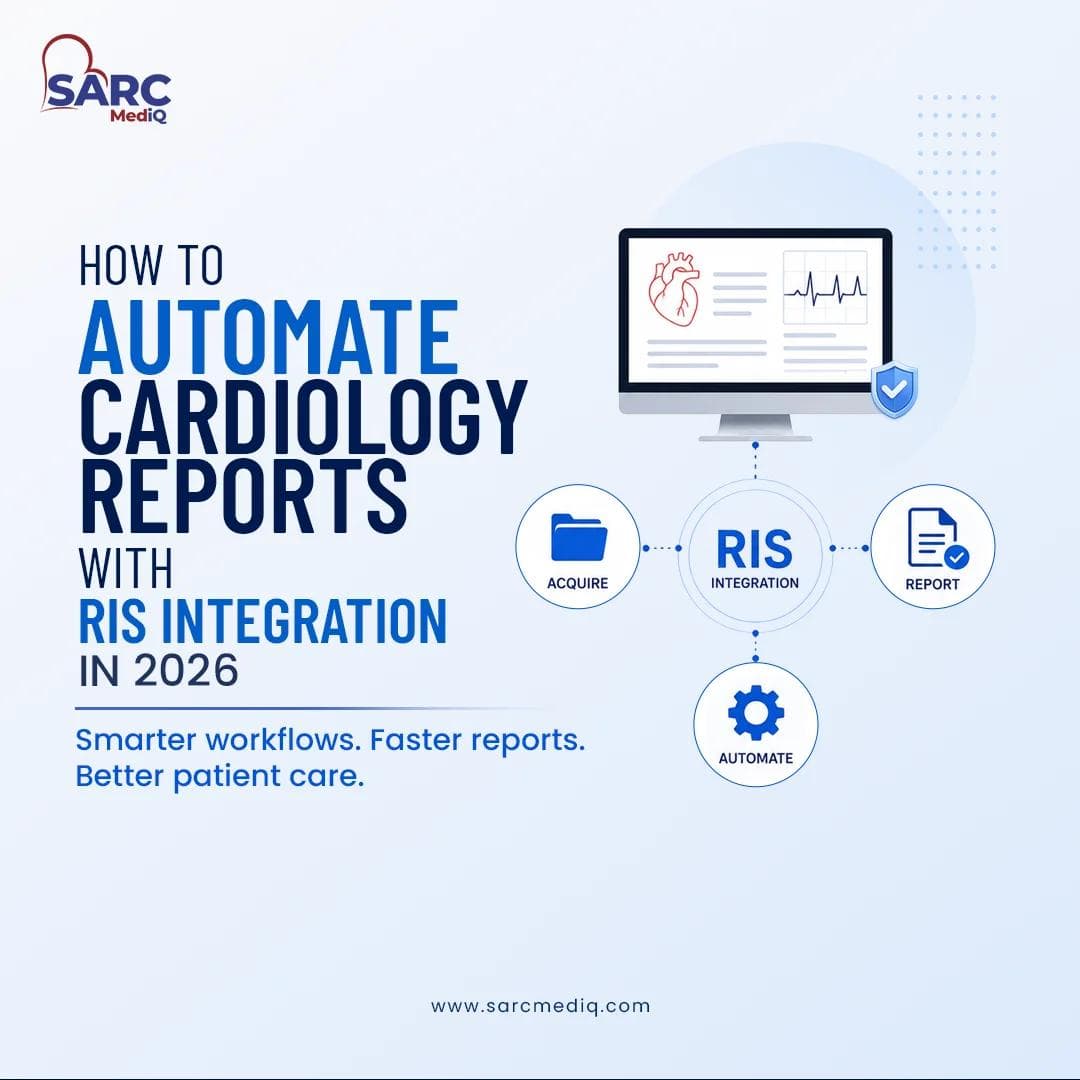
To automate cardiology reporting with RIS integration, you connect your radiology information system to your reporting workflow so patient demographics, order details, and clinical indications flow straight into structured report templates, and AI-generated measurements join them without retyping. A RIS is the software that schedules exams, tracks orders, and manages patient data across an imaging department. The integration is the project. Get the data flowing and the reports nearly write themselves.
What is RIS integration in cardiology reporting?
RIS integration connects the radiology information system, which holds the patient record, the exam order, and the schedule, to the cardiology reporting tools. Through HL7 messages or FHIR APIs, order data populates the report automatically. Completed reports flow back to the RIS and the EHR, and billing systems can pull codes from the structured text. Nobody retypes the patient's name, the referring physician, or the reason for the exam.
Two related systems matter here. The PACS stores the images. The modality worklist, usually fed by the RIS, tells each ultrasound machine which patient is on the table. When all three talk to the reporting layer through standard interfaces, the report starts half-written before the cardiologist opens it.
How does RIS integration change the daily workflow?
It deletes the typing between steps. Orders, demographics, and indications arrive in the report on their own. AI fills the measurements. The cardiologist edits and signs. A workflow that used to stall at three separate re-entry points now moves in one continuous pass from order to signed report.
The automated workflow runs in six steps:
- The order is placed in the RIS with the clinical indication attached.
- The modality worklist pulls patient and order data to the ultrasound machine. No manual entry at the console.
- The study is acquired. Images and DICOM SR measurements travel to the PACS.
- AI segments the images, calculates measurements, and populates a structured template. The order data is already in the header.
- The cardiologist reviews, edits, and signs. This step stays human, always.
- The final report transmits to the RIS, EHR, and registries. Structured fields feed billing.
Compare that with the old way, which has the same six steps but with manual re-entry at steps two, four, and six. Each re-entry point is a delay and an error source. Integration does not add steps. It deletes the typing between them.
Which integration architecture should you choose?
Three architectures dominate cardiology reporting integration: native tools built into your RIS or PACS, bolt-on tools connected through DICOM or HL7 messaging, and API-based exchange using HL7 FHIR. The right choice depends on your RIS vendor, your PACS, and how much IT help you actually have behind you.
Native integration embeds the reporting and AI tools directly inside the RIS or PACS. Results render in real time with no screen switching. It is the smoothest experience, but it narrows your vendor choices and ties your roadmap to one company's releases.
Bolt-on integration connects external tools through DICOM routing or HL7 messaging. This fits mixed-vendor departments and legacy RIS environments because it uses the standards every system already speaks. Expect some latency and a real need for interface monitoring.
HL7/FHIR API integration exchanges data through direct application interfaces. FHIR, the newer HL7 standard, offers the most flexibility for multi-site groups and custom workflows, at the cost of more upfront mapping and build effort. Most labs still run HL7 v2 messaging today, with FHIR adoption growing.
| Architecture | How it works | Best when | Watch out for |
|---|---|---|---|
| Native in RIS/PACS | AI and reporting built into your existing system | Single-vendor shop; you want minimal friction | Vendor lock-in; fewer AI options |
| Bolt-on via DICOM/HL7 | External tools connect through standard messages | Mixed vendors or a legacy RIS you are keeping | Some latency; interfaces need monitoring |
| HL7/FHIR API | Direct API data exchange between systems | IT capacity, multi-site groups, custom workflows | More upfront mapping and testing |
My advice: choose based on your RIS vendor and your IT bench, not the brochure. A bolt-on HL7 interface you can actually support beats a native integration your vendor deprioritizes.
What does the automation stack include?
Five components, each doing one job: the PACS holds the images, AI modules take the measurements, structured templates hold the format, the interface engine moves the data, and the dashboard watches it all. Miss any one of them and the automation has a gap.
- Cloud PACS. The image backbone. Stores studies, serves them anywhere, and keeps the archive off your local servers.
- AI measurement modules. Echo segmentation, ejection fraction and strain calculation, valve assessment support. Confirm FDA clearance for each module you switch on.
- Structured reporting templates. ASE-aligned fields for echo, with STS and ICAVL registry fields where they apply. Templates are what make reports consistent and auditable.
- Interface engine. Routes HL7 orders, DICOM images, and FHIR resources between systems, with monitoring and alerting when a feed stalls.
- QA and analytics dashboard. Tracks turnaround, completeness, edit rates, and interface uptime in one place.
SARC MedIQ packages these as one cloud-native workflow: DICOM routers, HL7/FHIR gateways, and a vendor-neutral API layer, with real-time interface monitoring. SARC MedIQ reports that more than 2,000 physicians and 300-plus facilities run on its platform.
How do structured templates use RIS data?
Structured templates turn RIS order data into report fields through field mapping. Patient demographics, the referring physician, and the clinical indication arrive in HL7 order messages and pre-fill the report header. DICOM SR carries the machine measurements. AI fills derived values like strain. The cardiologist adds the impression and signs.
The mapping looks like this in practice: RIS order message to report header fields. DICOM SR to measurement fields. AI output to derived and calculated fields. Procedure code from the order to template selection, so a stress echo automatically opens the stress template, not the TTE one. Every field lands in the same place every time, which is what makes the report registry-ready for STS or ICAVL submission without a second round of data entry.
Template discipline is also a compliance story. The 21st Century Cures Act information-blocking rules require prompt patient access to results, which punishes the old dictate-transcribe-fax chain. Structured reports that complete the same day keep you on the right side of that rule without heroics.
A concrete example helps. A stress echo order arrives from the RIS with the patient's age, the referring physician, and "chest pain on exertion" as the indication. The template opens the stress protocol automatically, the header fills itself, and after the study the AI populates wall-motion scores by segment. The cardiologist sees a complete draft where the only empty box is the impression. That is the whole trick: the template knows which study it is before anyone types.
How should you pilot cardiology reporting automation?
Run the pilot in six stages and resist the urge to skip any of them. Each stage answers one question: what do we have, does the data move, does the template work, do the doctors trust it, what broke, and are we ready to grow.
- Inventory every system that touches cardiology data: RIS, PACS, EHR, billing, and the registries you report to.
- Confirm the interfaces in a sandbox before touching production. Send test orders end to end and watch the data land.
- Configure one report type first. Transthoracic echo is the usual starting point: high volume, standardized, well understood.
- Pilot with two or three cardiologists for a few weeks. Measure turnaround time, report completeness, and how often the AI's values get edited.
- Fix what the data shows. Usually templates or mappings, rarely the AI model.
- Expand deliberately to stress echo, Holter and mobile telemetry, then device follow-up, one modality at a time.
Track interface uptime and message success rates alongside the clinical metrics. An automation project with a silent HL7 feed is a backlog wearing a costume.
What goes wrong most often?
Nearly every failed cardiology automation project I have seen broke at the interface, not the algorithm. The AI measured fine. The HL7 feed dropped the referring physician's name. Patient matching failed on hyphenated last names. Nobody owned the interface when the RIS vendor pushed an update, and the backlog quietly returned.
So here is the stance: start with the order, not the image. Nail the order-to-report data path first, then layer AI measurement on top of a pipeline you trust. And get the business associate agreement signed before any patient data moves, not after. Security paperwork is boring right up until it is the reason your project stops.
Governance deserves its own line item too. Someone must own template versions, approve AI model updates, and review the audit log monthly. When two cardiologists edit the same template differently, or an update quietly changes a measurement definition, the inconsistency creeps back that automation was supposed to kill. Put one name on that ownership, not a committee.
How do you keep reports consistent across multiple sites?
Centralize the templates and let the procedure code do the work. Every site draws from one template library, so a TTE reads the same everywhere. The RIS order's procedure code selects the template automatically, which removes the most common multi-site failure: the wrong form opened by habit. Then watch edit rates by site on the QA dashboard to spot training gaps early.
Frequently asked questions
No. Most automation projects keep the existing RIS and connect through bolt-on HL7 or DICOM interfaces, which is exactly what those standards exist for. Native integration is nicer when your RIS vendor offers it, but replacement is rarely the right first move. Replace the RIS when your organization outgrows it clinically or contractually, not because an automation vendor asked you to.
HL7 v2 is the long-standing messaging standard that carries orders, results, and admissions data between healthcare systems. It works, it is everywhere, and most cardiology interfaces still run on it. FHIR (Fast Healthcare Interoperability Resources) is the newer HL7 standard: API-based, web-friendly, and more flexible for multi-site and custom workflows, but it demands more upfront mapping and development. Expect to live with both for years.
A standard HL7 order-and-results interface can go live in weeks once mapping is agreed. Complex multi-site FHIR builds take months. The variable is almost never the software install; it is the mapping workshops, the test cycles, and waiting on the RIS vendor's interface queue. Ask any vendor for their last three go-live timelines with sites like yours, and believe the longest one.
It can be, and the checklist is short. The vendor must sign a business associate agreement, encrypt data in transit and at rest, maintain complete audit logs, and enforce role-based access. Ask for the BAA before the demo ends, not during contracting. A vendor that hesitates on the BAA will hesitate on everything else that matters.
Yes, provided the templates are structured per modality and the RIS order's procedure code drives automatic template selection. That last part is the one people forget: without procedure-driven templates, sonographers pick the wrong form and the automation gains leak away. Map every cardiology procedure code to its template during the pilot, and re-check the mapping quarterly as codes change.

Colin McCann, Ph.D.
Colin McCann, Ph.D., is the Co-Founder and CTO of SARC MedIQ, where he leads AI and healthcare imaging technology initiatives. His background spans machine learning, computer vision, cloud healthcare infrastructure, and large-scale medical data systems, with prior research experience at the National Institutes of Health and the University of Maryland. He specializes in building scalable AI-driven solutions for medical imaging, reporting, and healthcare workflow automation.